
Compare subcontractor quotations on scope, programme, attendance and commercial basis before choosing the number that enters the estimate.
- The lowest subcontractor quote is not automatically the lowest package cost
- Start with one enquiry basis
- Build a quotation comparison register
- Normalise scope before price
- Price the gaps outside the quotation
- Check programme, logistics and commercial terms
- Record the selected package basis
- How Quotify supports subcontractor review
Three subcontractors can price the same package and return three completely different scopes.
One includes design, access equipment and waste removal. Another assumes those items are by the main contractor. A third gives the lowest total but qualifies the programme, excludes making good and prices an earlier drawing revision.
Putting the three totals beside each other does not create a meaningful comparison.
The useful question is not, “Which quotation is cheapest?”
It is, “What will this package cost us on the basis required by this project?”
The lowest subcontractor quote is not automatically the lowest package cost
A subcontractor quotation is a commercial offer for a stated scope and basis. It is not a number that can be dropped into an estimate without interpretation.
The main contractor may still need to allow for items outside the quotation, including:
- attendance, welfare and temporary services
- scaffolding, hoists or access equipment
- unloading, distribution and storage
- setting out, protection and making good
- design responsibility, calculations or samples
- builders’ work in connection
- waste removal and final cleaning
- programme disruption or out-of-hours working
A lower quotation can therefore produce a higher adjusted package cost.
RICS guidance on subcontracting strategy and procurement explains that subcontract packages and the route used to procure them need to align with the main contractor’s programme, scope and commercial requirements. The practical implication for an estimator is simple: compare the offer against the package you need, not against the other headline totals.
Start with one enquiry basis
Comparison becomes easier when every tenderer receives the same enquiry information.
Issue a controlled pack containing, where relevant:
- a package scope or pricing schedule
- the drawing and specification register
- relevant revisions and addenda
- programme dates and sequencing constraints
- site access and logistics information
- required design responsibilities
- main-contractor attendance being provided
- the return date, validity requirement and pricing format
If different subcontractors priced different information, record that immediately. Do not hide the mismatch by forcing every quotation into the same spreadsheet columns.
Use the guide to creating a scope of works from construction drawings if the enquiry scope still needs to be reconciled from the project pack.
Build a quotation comparison register
Keep the original quotation intact and analyse it in a separate comparison register.
| Field | What to record | Why it matters |
|---|---|---|
| Quotation reference | Supplier, date and revision | Prevents the wrong return being used |
| Document basis | Drawings, specification and addenda priced | Exposes revision differences |
| Base price | Quoted package total before adjustments | Preserves the subcontractor’s offer |
| Inclusions | Work expressly covered | Shows what the price buys |
| Exclusions | Work expressly omitted | Identifies costs retained by the contractor |
| Qualifications | Conditions, limits and assumptions | Reveals where the price may change |
| Programme | Duration, lead time and working assumptions | Tests deliverability |
| Commercial basis | Validity, payment, tax and fluctuation wording | Checks whether the offer fits the main tender |
| Estimator adjustments | Additions, deductions and reasons | Creates the comparable package total |
The register should distinguish what the subcontractor said from what the estimator has adjusted. Overwriting the quoted total destroys that audit trail.
Normalise scope before price
Compare each quotation against the enquiry scope line by line or package section by package section.
Give each requirement a simple status:
- Included: clearly covered by the quotation.
- Excluded: expressly omitted.
- Qualified: included only on a stated assumption.
- Unclear: the quotation does not provide enough information.
- Not applicable: deliberately outside this package.
Do not treat silence as inclusion. Ask a clarification question where the item materially affects scope, programme or cost.
This is different from comparing main-contract tenders for a client. The main contractor is using the subcontract return to build its own price and will carry the consequence if a package interface is missed.
Price the gaps outside the quotation
Once the scope has been normalised, convert missing items into visible estimator adjustments.
For example, if one roofing contractor excludes scaffold while another includes it, do not simply mark the first quotation as incomplete. Add a supportable scaffold allowance to its comparison column, state the evidence and identify whether the cost sits in the roofing package or main preliminaries.
Use separate rows for:
- scope additions
- scope deductions
- main-contractor attendance
- design or compliance costs
- programme and logistics adjustments
- risk allowances pending clarification
Do not use an unexplained balancing figure to make the quotations appear comparable. If an adjustment has weak evidence, label its confidence and keep the uncertainty visible.
Check programme, logistics and commercial terms
A technically complete quotation may still be unsuitable for the project.
Check whether the subcontractor’s proposed lead time, duration, sequencing and working hours match the main programme. Confirm who owns access, lifting, protection, storage, permits and coordination.
Then review the commercial basis. Important differences may include quotation validity, price fluctuation wording, payment assumptions, bonds, warranties, retention, tax treatment and responsibility for design or testing.
This is a commercial review, not legal advice. Any proposed subcontract conditions should be checked by the appropriate person before appointment.
Record the selected package basis
The estimate should show more than the name of the preferred subcontractor and one total.
Record:
- the quotation reference used
- the adjusted package total
- the inclusions relied upon
- the costs retained elsewhere in the estimate
- open clarifications
- the expiry or review trigger
- who approved the basis
If the subcontractor later answers a clarification or changes its offer, update the comparison deliberately. Do not let a revised email silently replace the package basis used for the main tender.
How Quotify supports subcontractor review
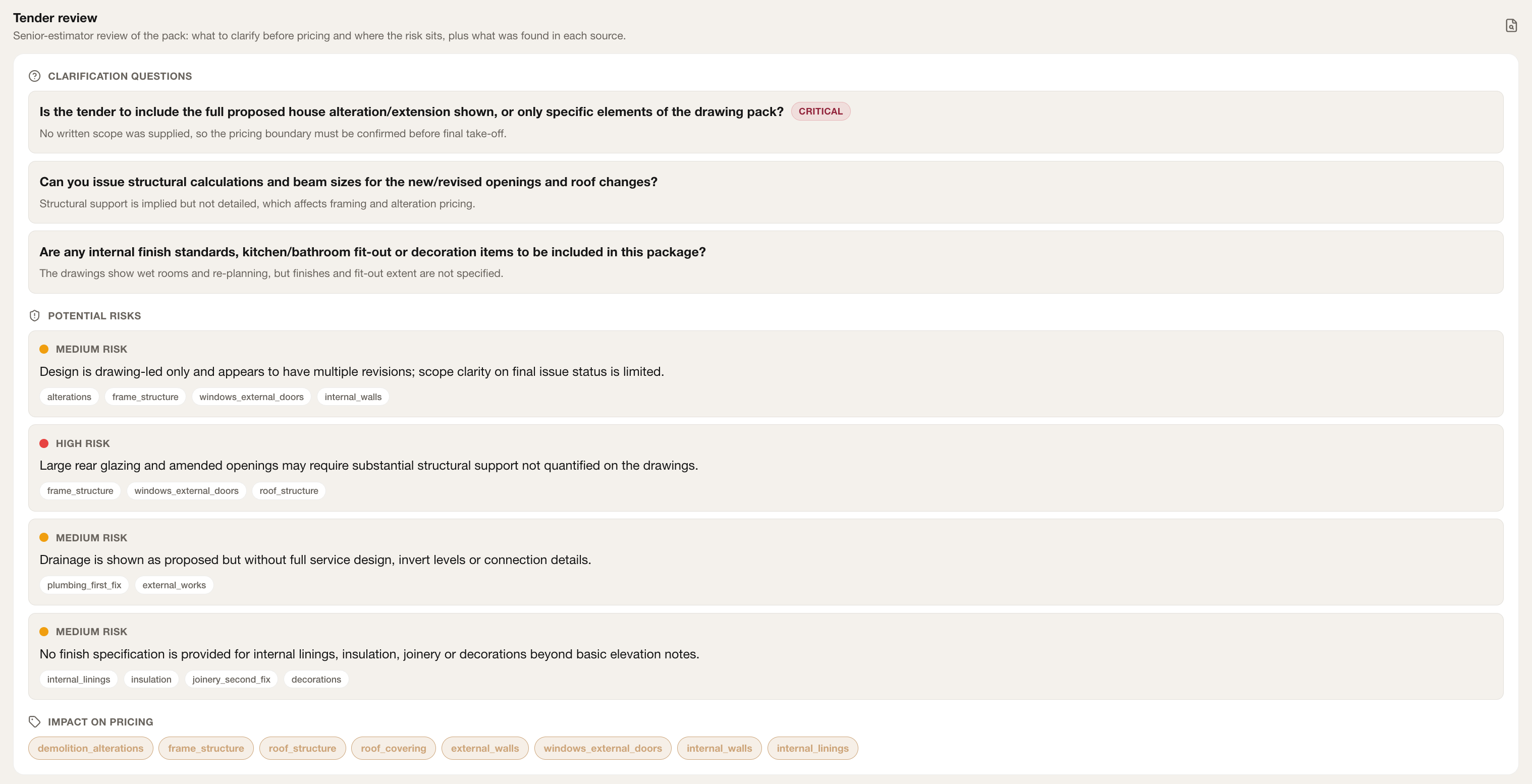
Quotify can help organise project information, tender comparisons, scope risks and clarification questions into a structured first pass.
The contractor still decides which subcontractor is appropriate, whether the quotation is commercially acceptable and what package value belongs in the estimate.
If you are pricing a live project, use Quotify to structure the project scope and review the package basis before a subcontract figure enters the final price.
FAQs
How should subcontractor quotes be compared?
Compare each return against the same document and package basis, then normalise inclusions, exclusions, qualifications, attendance, programme and commercial terms before comparing adjusted totals.
Should the lowest subcontractor quote be used in an estimate?
Not automatically. Use the quotation that provides the most appropriate scope and commercial basis after the cost of gaps, attendance and risk has been made visible.
What is a subcontractor quotation comparison sheet?
It is a controlled register that preserves each quoted price and records scope coverage, exclusions, qualifications and estimator adjustments so the package totals can be compared on a consistent basis.
How should unclear subcontractor scope be treated?
Raise a clarification where possible. If the main tender must proceed before an answer arrives, record a visible assumption or risk allowance rather than treating silence as confirmation.
What subcontractor quotation should be recorded in the estimate?
Record the quotation reference, adjusted package value, relied-upon inclusions, retained costs, open clarifications, review trigger and approval basis.
Use this thinking on a real project pack
Send drawings, specifications, notes or a current quote. Quotify will show how the project can be structured for review.