Quotify Academy · Getting Started

Set up Quotify around the way your business prices

A complete, screenshot-led walkthrough of Settings: establish your identity, commercial defaults, rate libraries and workspace branding before starting live estimates.

01
Profile & locale

Make every quote use the right identity and regional format

Business value: prevents incorrect currencies, dates and contact details from carrying into everyday work or confusing colleagues reviewing the same account.
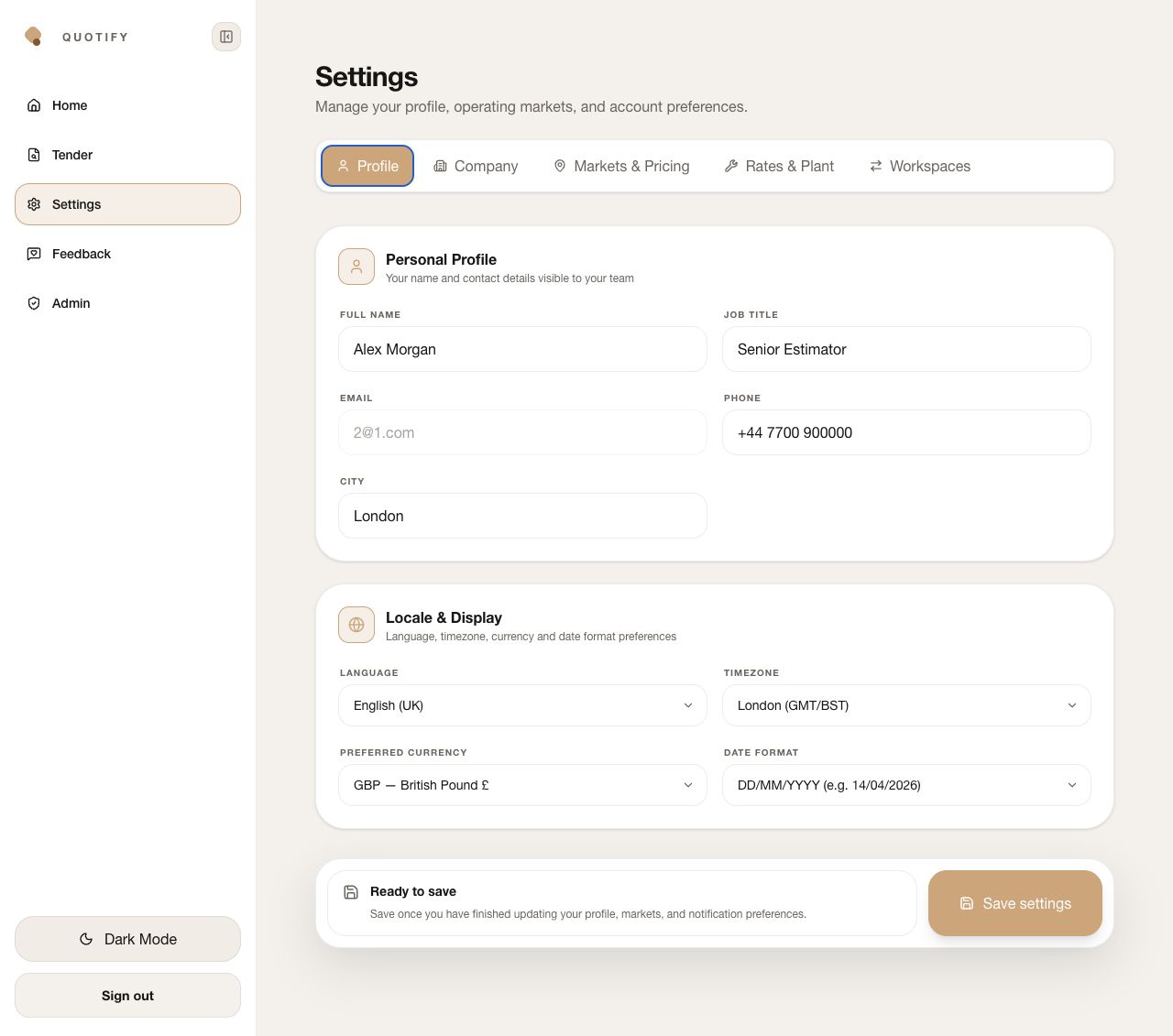
Quotify Profile settings showing personal details, locale, currency, date format and Save settings 1 2 3 4 5
Start in Settings, complete the Profile tab and confirm the display rules that Quotify will use.
  1. Settings tabs

    Use Profile, Company, Markets & Pricing, Rates & Plant and Workspaces as one setup sequence. Complete them before relying on generated quote defaults.

  2. Personal profile

    Add the name, job title, phone and city that colleagues should recognise. The sign-in email is account-controlled and cannot be edited here.

  3. Contact information

    Keep the phone and city current so the team knows who owns the estimating decisions. These are account details, not a substitute for the client-facing company contact.

  4. Locale & display

    Choose language, timezone, preferred currency and date format. These settings reduce ambiguity in deadlines, reports and cross-market cost reviews.

  5. Save settings

    Save only after the full setup pass. Changing a visible field without saving does not establish a durable account default.
02
Company & reports

Control what clients see and how Quotify benchmarks the business

Business value: makes exported documents look intentional and gives Quotify the business context needed for appropriate templates, rules and comparisons.

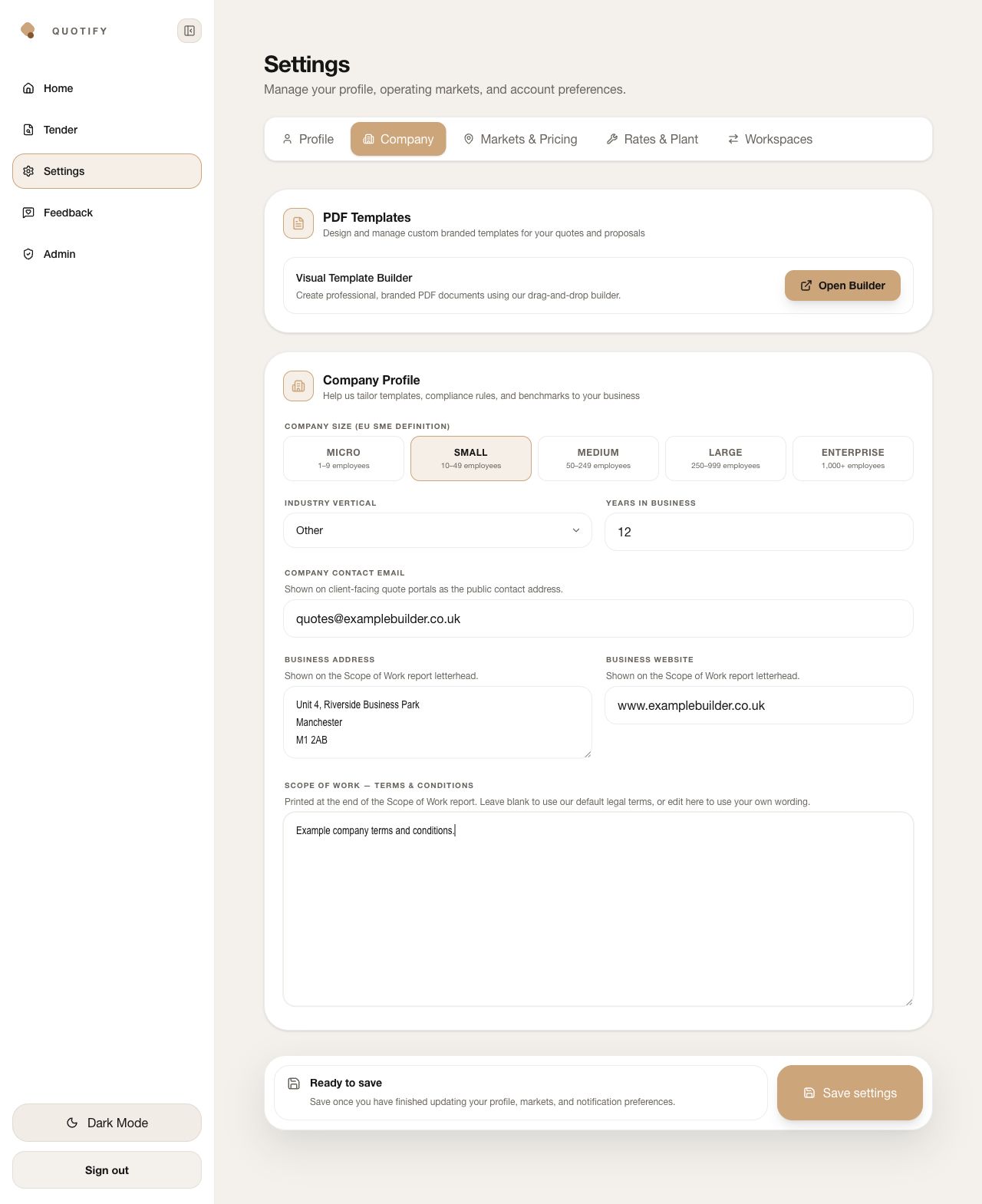
Quotify Company settings showing PDF Template Builder, company profile, public contact, address, website and terms 1 2 3 4 5 6
Company settings connect account context, branded PDFs and client-facing report information.
  1. Visual Template Builder

    Open the builder when you need branded quote and proposal layouts. Treat the saved template as part of document control, not decoration added after issue.

  2. Company size

    Select the closest EU SME band. It helps Quotify tailor templates, compliance assumptions and benchmarks to the scale of the business.

  3. Industry and experience

    Choose the main vertical and enter years in business. Use the activity that best represents the work you price most often.

  4. Client-facing details

    Enter a monitored company email, postal address and website. These feed quote portals and Scope of Work letterheads, so check spelling and ownership.

  5. Terms & conditions

    Leave blank to use Quotify’s default wording or add your approved company terms. Have material legal or payment wording reviewed before relying on it.

  6. Save the company profile

    Save, then generate a test Scope of Work to confirm the letterhead, contact details and terms appear as intended.

03
Markets & pricing

Set the commercial baseline before Fast Pass starts calculating

Business value: replaces generic assumptions with a consistent market, labour and pricing profile so every new estimate starts closer to the way the business actually prices.

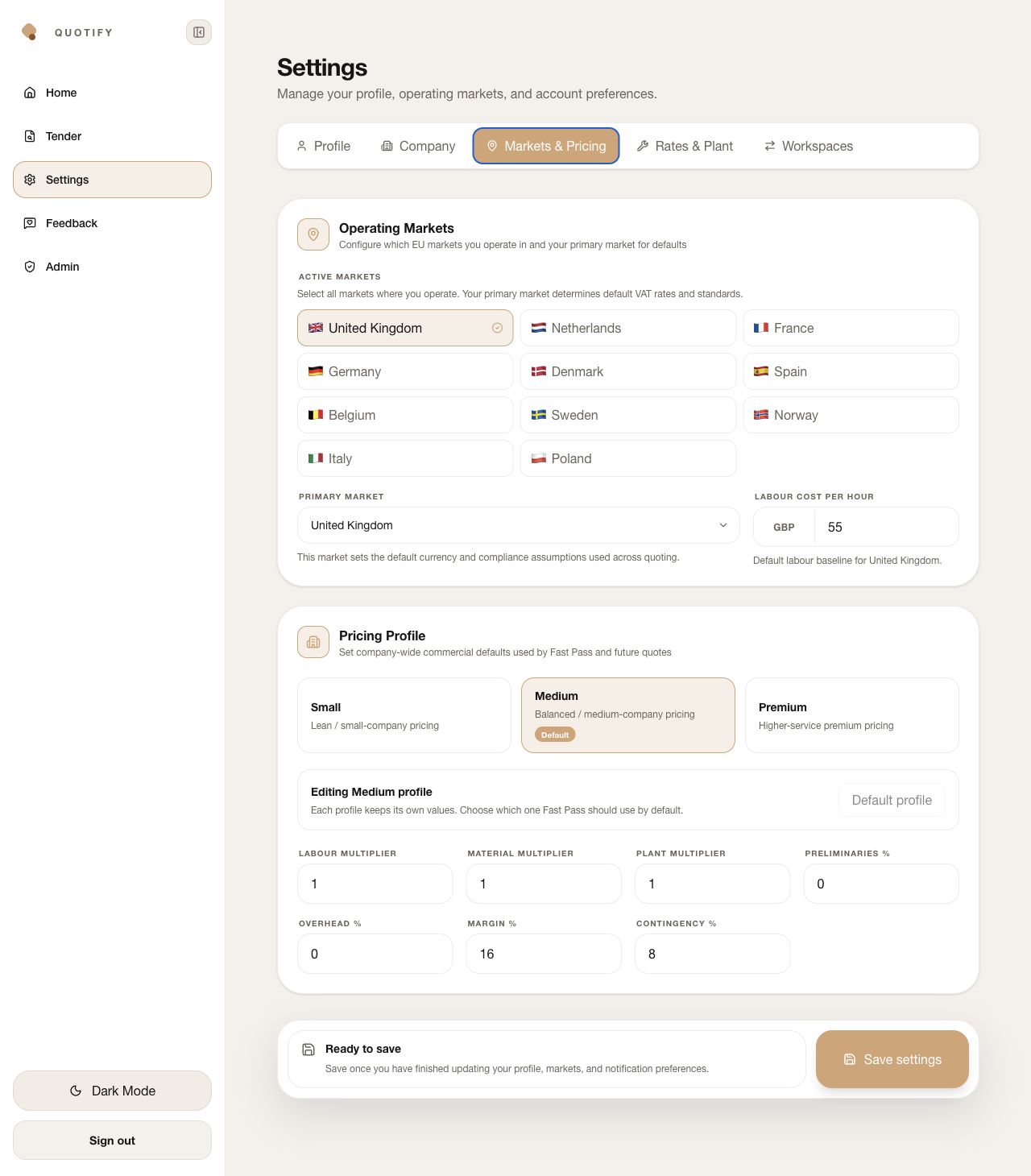
Quotify Markets and Pricing settings showing active markets, labour baseline, pricing profiles and commercial percentages 1 2 3 4 5 6
Market and pricing settings define the currency, labour baseline and commercial profile used by future quotes.
  1. Active markets

    Select every country where the business operates. Add markets only when you understand the associated tax, currency, standards and delivery implications.

  2. Primary market and labour cost

    The primary market drives default currency and compliance assumptions. Enter a realistic hourly labour baseline for that market, including the cost basis your estimators normally use.

  3. Pricing profiles

    Maintain separate Small, Medium and Premium profiles, then choose the one Fast Pass should use by default. A premium profile should reflect a genuine service or cost difference.

  4. Cost multipliers

    Use labour, material and plant multipliers for consistent company-wide adjustments. Avoid using them to conceal an incorrect base rate.

  5. Preliminaries, overhead, margin and contingency

    Keep these concepts separate. They protect different costs and risks, and combining them makes reporting and post-job learning harder.

  6. Save and test

    Save the profile, create a non-urgent test Fast Pass and confirm that its labour and commercial totals reflect the chosen baseline.

04
Rates, plant & libraries

Turn business knowledge into reusable pricing evidence

Business value: lets Fast Pass use your known plant, trade and supplier rates instead of relying on generic allowances wherever a reliable match exists.

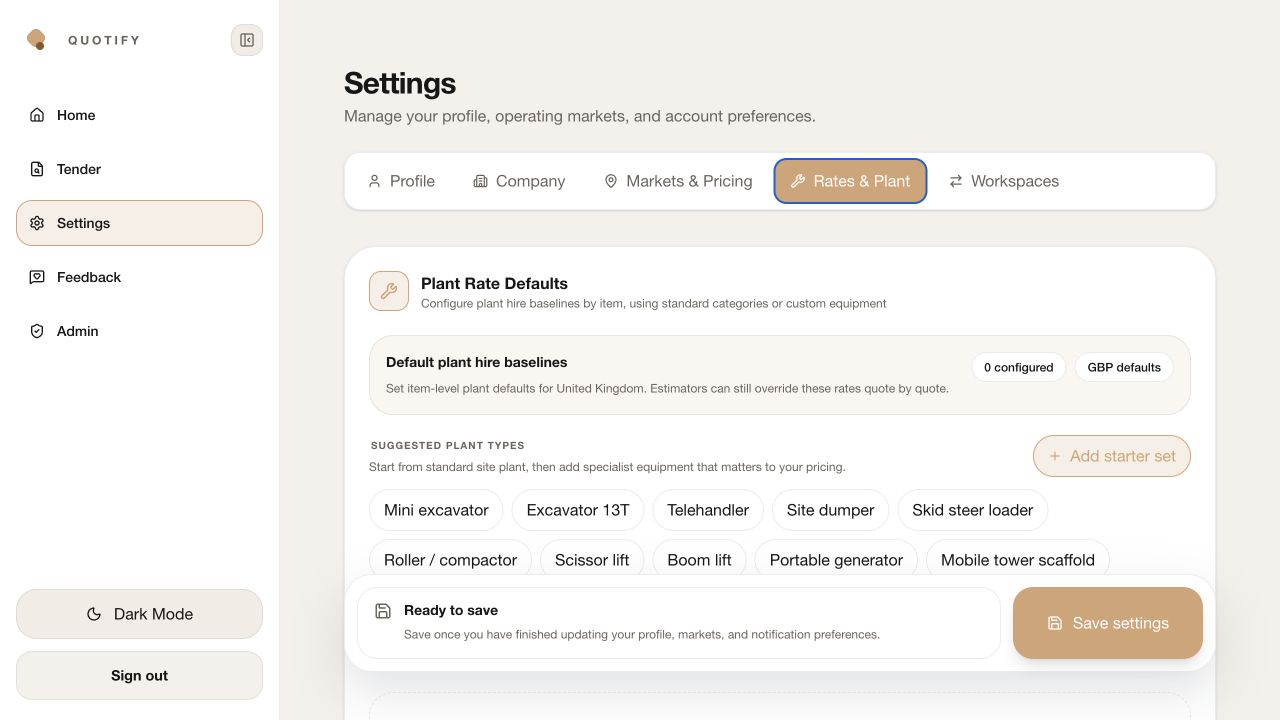
Quotify Plant Rate Defaults showing standard plant types and starter set controls 1 2 3
Build plant defaults from common items, then add specialist equipment that materially affects your work.
  1. Rates & Plant tab

    This area holds reusable cost evidence. Estimators can still override it quote by quote when the project conditions justify a different rate.

  2. Suggested plant types

    Add only equipment the business prices regularly and enter a clear unit basis—such as day, week or item—so the allowance cannot be misread.

  3. Starter and custom plant

    Use the starter set for common site plant, then add specialist equipment by a recognisable name. Review hire rates when suppliers or fuel costs change.

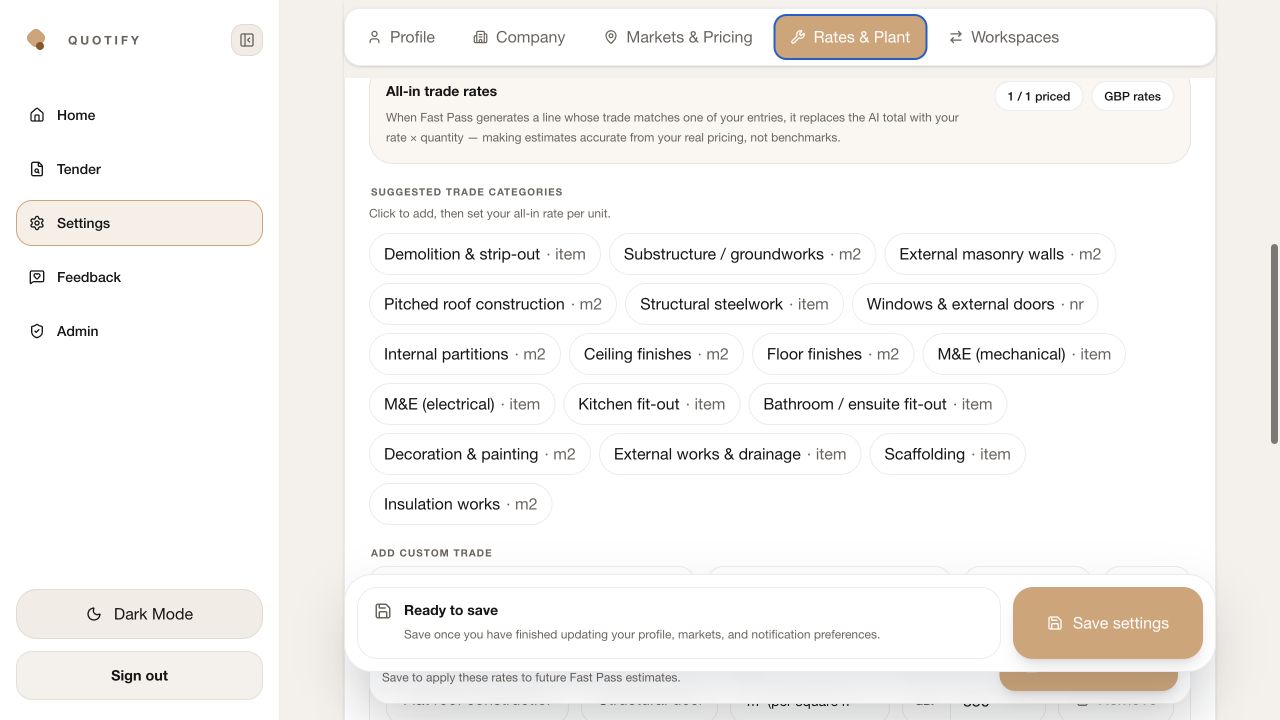
Quotify Contractor Rate Card showing suggested trade categories and custom rate controls 1 2 3
Trade rates replace matched AI totals with your all-in rate multiplied by the extracted quantity.
  1. All-in trade rates

    Understand the rule before adding rates: when a generated trade matches, Quotify uses your rate × quantity. The unit and scope definition therefore matter as much as the price.

  2. Suggested categories

    Add the trades you price consistently, then check whether each is per m², metre, item, number, day or another unit.

  3. Custom trade entries

    Use a clear trade name, optional scope note, unit and all-in rate. Save the rate card separately so future Fast Pass estimates can use it.

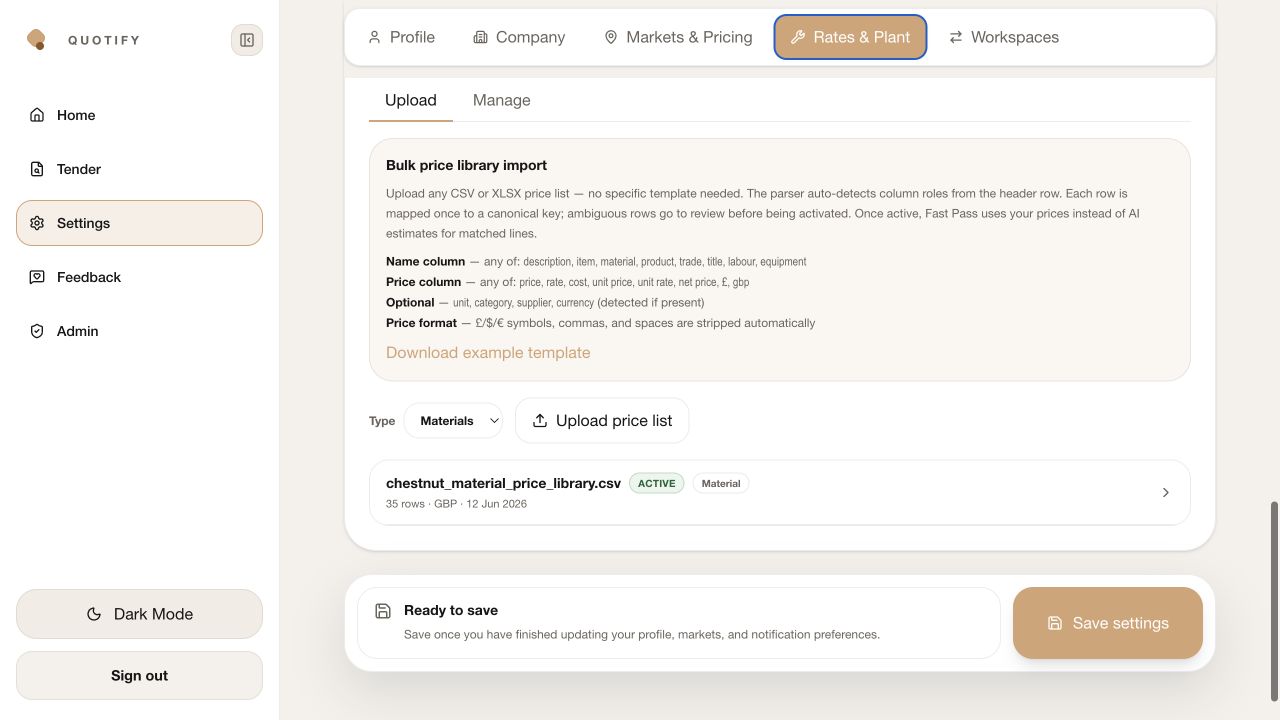
Quotify Price Library Import showing upload guidance, file type, price-list upload and active library 1 2 3 4
Bulk import lets Quotify match a larger materials, labour or plant library while holding ambiguous rows for review.
  1. Upload and Manage

    Use Upload for a new CSV/XLSX and Manage to inspect the rows already mapped or awaiting review.

  2. Import requirements

    Provide a recognisable name and price column. Unit, category, supplier and currency improve matching and reduce ambiguous rows.

  3. Library type and upload

    Choose Materials, Labour or Plant before uploading. Do not mix incompatible rate types in one file unless the source structure clearly separates them.

  4. Active libraries

    Confirm row count, currency, import date and Active status. An uploaded file does not influence Fast Pass until the required mappings are confirmed and active.

05
Workspaces & branding

Keep each business identity and its output correctly separated

Business value: prevents one company’s logo, pricing context or report identity from appearing in another workspace’s client documents.

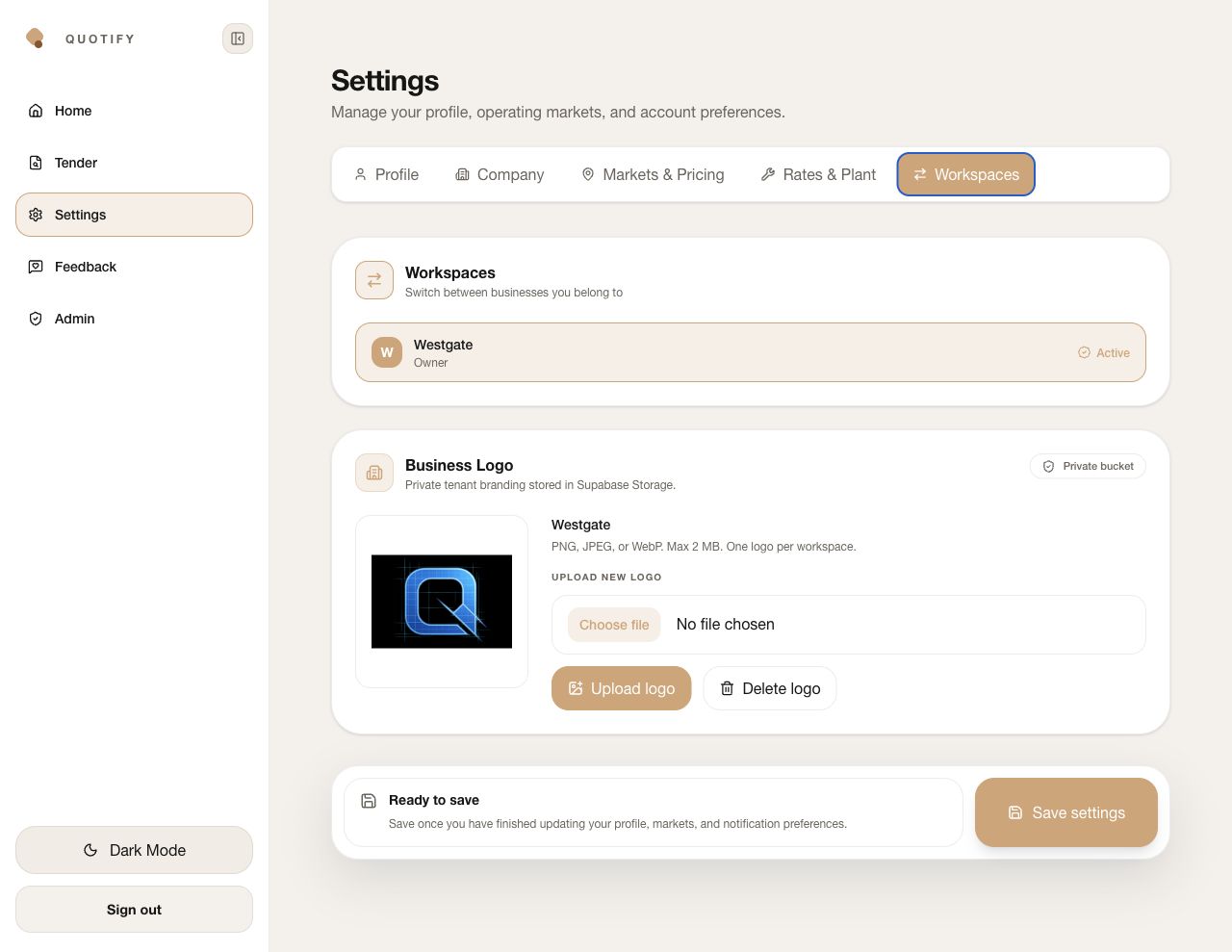
Quotify Workspaces settings showing active business, private logo storage and upload controls 1 2 3 4 5 6
Confirm the active business before changing private branding or saving workspace-specific choices.
  1. Workspaces tab

    Open this tab whenever you belong to more than one business or are checking which company context is active.

  2. Active workspace

    Confirm the business name, role and Active indicator before editing company-specific settings or creating a quote.

  3. Business logo

    The logo is stored privately for that workspace and appears in supported branded outputs. Use a clear PNG, JPEG or WebP no larger than 2 MB.

  4. Choose and upload

    Select the correct file, then upload it. Generate a test report to check legibility, spacing and contrast at normal document size.

  5. Delete logo

    Delete only when the workspace should return to unbranded output or the asset is being replaced. Check the active workspace first.

  6. Final save

    Save the completed account setup and run one test Fast Pass plus one test report before using the defaults on urgent live work.

Final gate

Before you rely on the account defaults

  • Profile, timezone, currency and date format match the operating team
  • Company contact, address, website and approved terms are client-ready
  • Primary market and labour baseline are commercially realistic
  • Default pricing profile keeps preliminaries, overhead, margin and contingency separate
  • Plant and trade rates have clear units and current evidence
  • Imported libraries show the correct type, currency, row count and Active status
  • The active workspace and logo match the business issuing the quote
  • A test estimate and report have been checked before urgent live use