
Build labour cost from a defined employment cost, realistic productive time and project-specific output—not a wage multiplied by nominal days.
- Separate labour cost from labour output
- Define what the labour rate includes
- Convert paid time into productive time
- Build output from the actual work
- Adjust for project conditions
- A worked estimating example
- Check the labour allowance
- Keep labour evidence current
- How Quotify supports labour review
A construction labour allowance can be wrong even when the hourly rate is right.
The usual problem is that two different questions have been compressed into one number:
- What does an hour of labour cost the business?
- How many productive hours will this item require on this project?
Those questions should be calculated and reviewed separately.
A credible labour estimate is:
defined labour cost × realistic productive time
The calculation is simple. The judgement sits inside the definitions and assumptions.
Separate labour cost from labour output
Start by deciding how the work will be delivered.
Direct employees, labour-only subcontractors, agency operatives and specialist subcontract packages do not have the same cost basis or commercial treatment.
For directly employed labour, the estimator needs an employment-cost rate and a productivity assumption. For a labour-only subcontractor, the agreed charge may already cover costs that the employer would otherwise calculate separately. For a complete specialist package, forcing the quotation back into an artificial labour rate may add noise rather than control.
Use the method that matches the procurement decision, and state it.
Define what the labour rate includes
A wage is not automatically the cost of an operative to the business.
Depending on the employment arrangement, a labour cost build-up may need to consider:
- basic pay
- employer National Insurance where applicable
- pension contributions
- paid holiday and other paid non-working time
- training, certification and required checks
- personal protective equipment and small tools
- travel or subsistence where the business carries it
- agency or labour-provider charges
Do not add every business overhead into the labour rate without a policy. Decide whether supervision, vehicles, office overhead and profit sit in the labour rate, preliminaries or a separate commercial uplift. Consistency matters because hidden overlap can recover the same cost twice.
Statutory rates and thresholds change. Use current payroll information and check the latest GOV.UK National Insurance rates and allowances rather than copying an old percentage from a previous estimate.
RICS New Rules of Measurement provides recognised measurement guidance for building work. You do not need to force every contractor estimate into a bill-of-quantities format, but consistent descriptions, units and pricing rules make labour assumptions easier to review.
Convert paid time into productive time
Paid hours and productive installation hours are not identical.
A working day can include:
- site induction and briefings
- moving materials and tools
- setting out
- waiting for access or preceding work
- breaks and welfare time
- cleaning and protection
- minor rework
Some of that time belongs in the measured item; some may be better carried in preliminaries or a separate activity. The important control is that it appears somewhere once.
Do not turn a nominal eight-hour day into eight productive installation hours unless the work and records support that assumption.
The guide to construction estimating time separates active estimating, waiting and review time; apply the same discipline when labour duration depends on access, information or preceding work.
Build output from the actual work
Productivity should describe the relationship between a defined quantity and the labour time required to complete it.
Record at least:
- the work description and specification
- the unit of measurement
- the assumed gang composition
- the expected output per hour or day
- what supporting tasks are included
- the source of the assumption
- the project conditions in which it is valid
An output for clear new-build work at ground level may be a poor basis for a phased refurbishment with occupied areas, restricted access and extensive protection.
Historical records are useful when the previous work is genuinely comparable. A rate saved without its scope and conditions is only a number. The guide to building a controlled construction rate library explains how to preserve that evidence.
Adjust for project conditions
Review productivity against the job being priced.
Common adjustment triggers include:
- refurbishment rather than uninterrupted new work
- small, repeated or fragmented work areas
- restricted delivery and storage
- work at height or difficult access
- occupied premises and working-hour restrictions
- complex setting out, interfaces or temporary works
- weather exposure
- sequencing around other trades
- high inspection, testing or finish requirements
Do not hide all difficult conditions inside one blanket productivity reduction. Identify the material conditions so the reviewer can challenge them and the delivery team can understand the basis.
A worked estimating example
Assume an estimator has identified 120 m² of a defined lining system.
The business’s evidence suggests that the proposed two-person gang can install 24 m² per productive day under the conditions assumed for this project. That creates five gang-days of installation:
120 m² ÷ 24 m² per gang-day = 5 gang-days
The estimator then reviews whether separate time is needed for mobilisation, setting out, material distribution, protection, interfaces and final snagging. If one additional gang-day is supportable, the pricing allowance becomes six gang-days.
If the defined employment cost is £X per operative-day, the direct labour cost is:
6 gang-days × 2 operatives × £X
The figures are illustrative, not an industry benchmark. The useful part is the audit trail: quantity, gang, output, supporting time and cost basis remain visible.
Check the labour allowance
Use more than one check where the package is commercially important.
- Unit check: compare labour hours per measured unit with reliable historical work.
- Duration check: ask whether the total gang-days fit the proposed programme.
- Resource check: confirm that the gang composition is realistic and available.
- Package check: compare self-delivery with a current subcontract quotation where appropriate.
- Value check: identify labour-heavy items whose output assumption materially changes the tender total.
A cross-check should challenge the estimate, not automatically replace the underlying calculation.
Before submission, use the construction estimating checklist to reconcile the labour allowance with quantities, programme, preliminaries and the client-facing price.
Keep labour evidence current
After project review, record which assumptions were accepted and why. When reliable delivery records become available, compare estimated and actual labour at the same scope level.
Do not learn the wrong lesson from an unexplained variance. The cause may be a changed scope, site delay, poor material flow, different gang composition or an unrealistic original output.
Update the rate or output only when the evidence is comparable. Keep the previous basis and review date so later estimates do not inherit a silent change.
How Quotify supports labour review
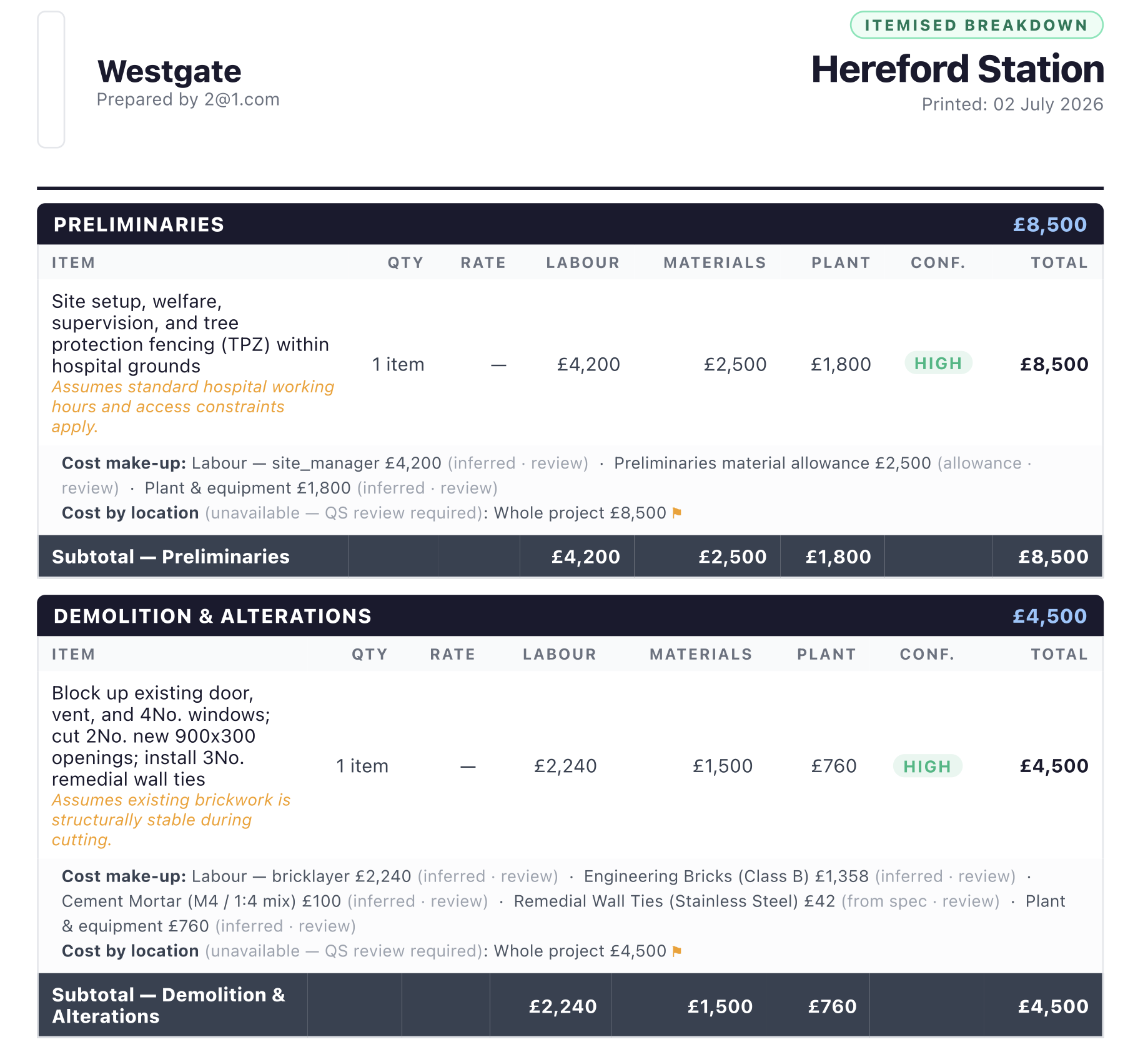
Quotify structures a first-pass estimate from drawings, specifications and project information, separating labour from materials, plant and subcontract costs for review.
The contractor remains responsible for the labour rate, gang, output, project adjustments and final commercial price.
If you have a live project to price, use Quotify to create the first-pass structure, then challenge the labour assumptions against how your business will actually deliver the work.
FAQs
How is construction labour cost calculated?
Define the relevant labour cost per hour or day, estimate the productive time required for the measured work, add visible project-specific support time and multiply the two. Keep overhead and profit treatment consistent.
What should a construction labour rate include?
It may include basic pay and applicable employer on-costs, paid non-working time, training, PPE, small tools, travel or provider charges. The exact basis depends on the employment arrangement and the contractor’s cost policy.
What is the difference between labour rate and productivity?
The labour rate is the cost of labour time. Productivity is the amount of defined work completed in that time. A credible estimate needs both.
Should an eight-hour day equal eight productive hours?
Not automatically. Site briefings, access, distribution, cleaning, protection and waiting can reduce installation time or need to be allowed elsewhere in the estimate.
How should labour productivity be checked?
Compare the assumption with reliable similar project records, the required duration, available resources and current subcontract quotations where appropriate, while accounting for project-specific conditions.
Use this thinking on a real project pack
Send drawings, specifications, notes or a current quote. Quotify will show how the project can be structured for review.