
Check the materials that can move the tender, compare the correct buying basis and record exactly which prices still need confirmation.
- Material price checking starts with scope
- Decide which material prices need checking
- Grade the pricing evidence
- Compare the same buying basis
- Build the landed material cost
- Check price timing and availability
- Use market indices as context
- Keep a material price review register
- Worked material price review
- Carry the decision into the tender
- How Quotify supports material price review
A material rate can be accurate and still produce the wrong tender.
The price may relate to the wrong specification, pack size, quantity, delivery basis or project date. It may exclude fixings, waste, offloading or a minimum-order charge. It may also be a sensible historical rate that has never been confirmed for the job being priced.
Checking construction material prices is therefore not a last-minute exercise in updating spreadsheet cells.
It is a controlled review of what the project requires, what the business will actually buy and what evidence supports the cost carried into the tender.
Material price checking starts with scope
Do not ask a supplier to price “insulation”, “blocks” or “roofing materials” without first defining the requirement.
The enquiry should identify, where relevant:
- product, grade, finish or performance requirement
- manufacturer or permitted equivalent
- unit, size and pack configuration
- measured quantity and waste basis
- delivery location, access and offloading needs
- required delivery period or call-off sequence
- fixings, accessories and ancillary products
- the drawing and specification revisions used
A supplier can only confirm the price of the product described. If the specification is incomplete, record the basis used and raise the gap instead of treating the returned price as certainty.
The guide to turning a construction specification into a pricing scope explains how to convert product and performance requirements into defined pricing actions.
Decide which material prices need checking
Not every material line deserves the same review effort. Start with the items that can materially change the project result.
Prioritise:
- high-value materials or packages
- products with an incomplete or unusual specification
- rates supported only by old estimates or memory
- special-order, imported or long-lead products
- items affected by minimum orders, pack sizes or large waste factors
- materials with difficult delivery, storage or offloading requirements
- client selections that remain undecided
- items whose price validity may expire before purchase
This is a sensitivity-led review. The estimator is directing limited time towards the material decisions most capable of changing the tender, not trying to obtain a fresh quotation for every screw and bag of cement.
Grade the pricing evidence
Every important material rate should show where it came from and how confidently it applies to the current project.
| Evidence level | Typical basis | Appropriate treatment |
|---|---|---|
| Project quotation | Current supplier return for the stated product, quantity, delivery and project | Check scope, validity and exclusions before approval |
| Current account price | Merchant or manufacturer price available to the business | Confirm quantity, delivery and availability |
| Reviewed library rate | Controlled rate with source, date and defined basis | Use where the current requirement matches; check material items that drive the total |
| Historical project rate | Previous estimate, order or project evidence | Use as a benchmark and obtain confirmation where exposure is material |
| Provisional allowance | Early assumption with limited evidence | Keep visible, state the basis and assign a confirmation action |
“In the spreadsheet” is not an evidence level. If nobody can identify the source, date or buying basis, the rate should be treated as unverified.
A controlled construction rate library makes this review faster by preserving the evidence behind reusable rates.
Compare the same buying basis
Two supplier totals are not comparable until the estimator knows what each includes.
Check:
- whether the quoted product meets the same specification
- whether quantities, units and pack sizes match
- whether discounts are project-specific, account-based or conditional
- whether delivery, offloading, pallets, crates or returns are included
- whether VAT is included or excluded
- whether accessories and consumables are included
- whether the quotation covers one delivery or several call-offs
- whether alternatives change installation labour, waste or warranty requirements
A cheaper alternative is not a saving if it changes the system being priced or creates cost elsewhere. Refer substitutions back to the specification, designer or appropriate project decision-maker before relying on them.
Build the landed material cost
The useful number is the cost of getting the required material to the point where the work can be carried out—not merely the catalogue unit price.
A material cost build-up may need to include:
required quantity + justified waste + pack or minimum-order effect + delivery and offloading + accessories + storage or handling + unrecoverable charges
Keep labour and plant visible as separate cost components where possible. If unloading requires a telehandler or restricted access creates additional distribution time, those costs still belong in the estimate even when they do not appear on the supplier quotation.
Check units carefully. A rate per pack, sheet, length, tonne or thousand items must be converted to the estimate unit without losing the pack yield or unavoidable remainder.
Check price timing and availability
A valid price today may not remain valid when the material is ordered.
Record the quotation date, expiry date, stated lead time, stock position and any condition that allows the supplier to revise the price. Then compare those dates with the tender validity period and programme.
If the contractor cannot secure the price before it expires, the commercial decision should be explicit. Options include obtaining a longer validity period, seeking a firm project quotation, reviewing the procurement programme, carrying an identified risk allowance or qualifying the tender basis where appropriate.
Do not automatically add a blanket percentage to every material. The exposure depends on the specific item, purchasing date, evidence and contract position.
Use market indices as context, not as the project price
The Department for Business and Trade publishes monthly building materials and components statistics, including construction material price indices.
The official methodology explains that these indices measure notional trends in input costs, such as factory-gate prices, and do not account for the project-specific market conditions, merchant discounts or scarcity premiums a contractor may face.
Use indices to challenge stale assumptions, understand broad movement and decide where fresh enquiries are justified. Do not use a national index as a substitute for a supplier price on a material item that could materially affect the tender.
Keep a material price review register
A concise register makes open pricing decisions visible during the final review.
| Field | What to record |
|---|---|
| Estimate reference | Work package and material line |
| Requirement | Product, specification, unit and quantity basis |
| Evidence | Supplier, quotation or library reference and date |
| Buying basis | Discount, delivery, VAT, pack size and ancillary inclusions |
| Validity | Expiry, lead time and intended order date |
| Status | Verified, reviewed, historical, provisional or awaiting clarification |
| Decision | Approved rate, adjustment, allowance, exclusion or action owner |
The register should point back to the original evidence rather than replace it. Preserve the supplier's wording and record estimator adjustments separately.
Worked material price review
Consider a flat-roof package where the estimate contains insulation, membrane, trims, outlets and fixings.
The insulation rate came from the rate library, but the current specification requires a different thickness. The membrane quotation is current but excludes delivery. The trims are priced per length while the estimate measures metres. The outlets appear on the drainage drawing but not in the roofing enquiry.
A useful review would:
- confirm the insulation product and obtain the correct pack coverage
- add delivery to the membrane buying basis
- convert trim lengths into the measured quantity with cutting waste visible
- assign the outlets to the correct package and obtain a price
- record the quotation validity against the anticipated order date
None of those actions requires changing every material rate. They correct the lines where scope, unit and commercial basis could move the package total.
Carry the decision into the tender
Before submission, reconcile the price register with the estimate and the client-facing quote.
Confirmed material costs should appear in the relevant package. Undecided client selections may require a clearly defined PC sum. Incomplete material scope may need an assumption, provisional allowance, risk treatment or exclusion that accurately describes the situation.
Use the fixed-price quote risk review to decide how unresolved price exposure will be treated, then complete the wider pre-issue estimating checklist.
If an important price is still unverified, do not make it look firm by removing the note. Make the uncertainty visible so the appropriate person can approve the tender basis.
How Quotify supports material price review
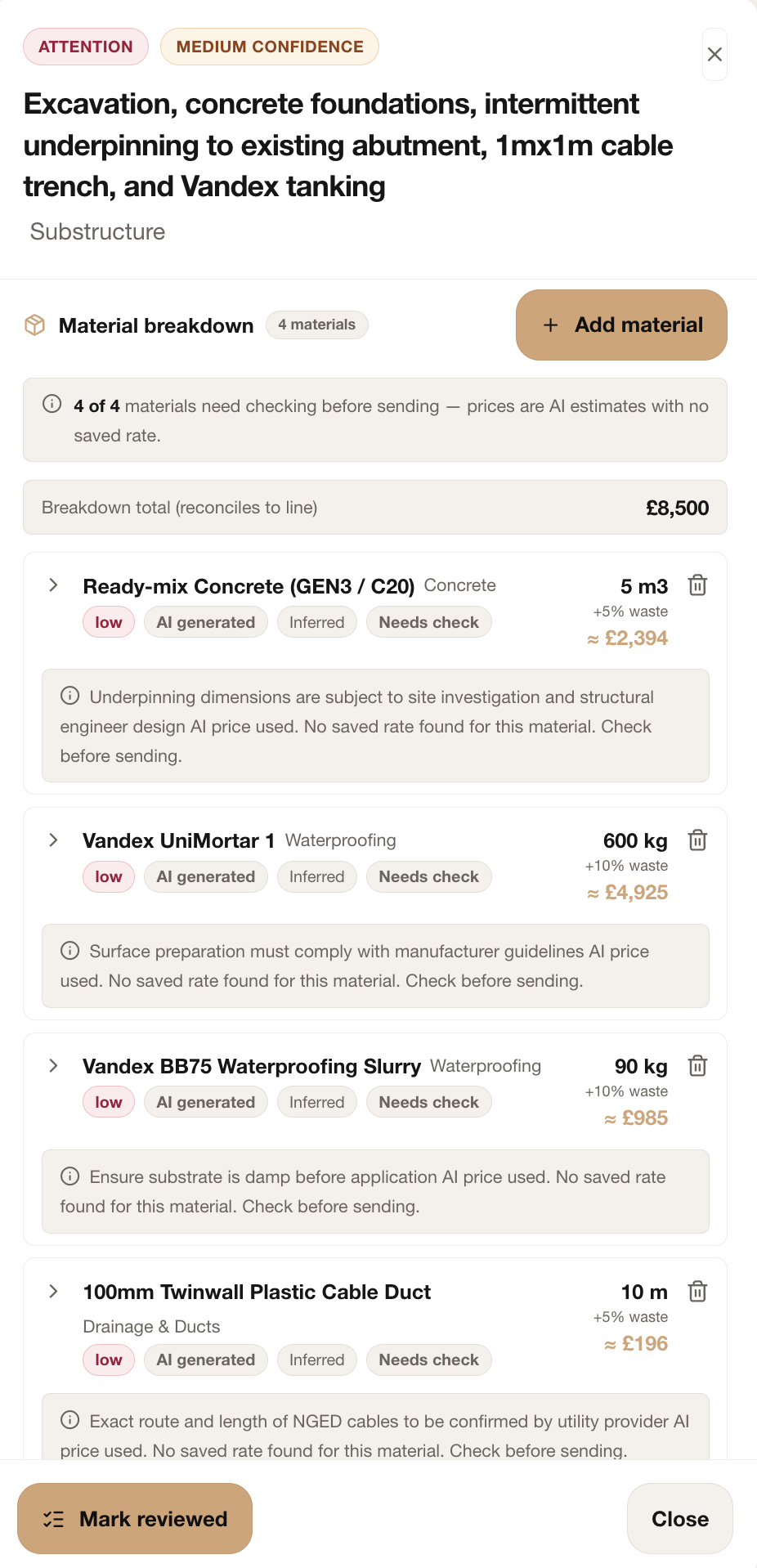
Quotify is designed to analyse uploaded project information, produce a structured first-pass estimate and support material price checking while leaving rates, margin and the final commercial decision with the contractor.
The useful outcome is not an automatic promise that every price is correct. It is a structured estimate that helps the user identify which materials require evidence, apply their own buying knowledge and retain control of the final price.
If you have a live project to price, send the drawings, specification and supporting project information through Quotify and compare the structured first pass with your current process.
Material price check before tender
- Confirm the product, performance and revision basis.
- Prioritise high-value, unusual, old or low-confidence rates.
- Record the evidence source and date for important items.
- Check units, pack sizes, minimum orders and justified waste.
- Include delivery, offloading, accessories and handling.
- Compare supplier returns on the same buying basis.
- Check validity, lead time and the intended order date.
- Use indices as context rather than a replacement for live pricing.
- Make unresolved prices visible as allowances, assumptions or risk.
- Reconcile the approved material basis with the final tender.
FAQs
How should construction material prices be checked before tender?
Define the product and quantity basis, prioritise the material lines that can move the project total, obtain or validate current evidence and check delivery, waste, pack sizes, validity and availability before approving the rate.
Can a builder use online material prices in an estimate?
Online prices can provide a useful check, but the estimator should confirm specification, account discount, quantity, delivery, VAT, availability and validity before treating the rate as a firm project cost.
Should every material price be updated for every tender?
Not necessarily. Direct review effort towards high-value, unusual, old, volatile or low-confidence items, while using controlled and applicable rates for routine materials.
Can construction material price indices replace supplier quotations?
No. Indices show broad market movement and can identify stale assumptions, but they do not reflect every project's specification, discount, quantity, delivery or local availability.
What should happen if a material price cannot be confirmed?
Record the evidence gap and choose a deliberate treatment, such as a defined allowance, assumption, qualification, risk allowance or exclusion, subject to the tender and contract basis.
What is included in landed material cost?
It is the cost of obtaining the required material for the project, including relevant quantity, waste, pack effects, delivery, offloading, accessories, storage, handling and unrecoverable charges.
Use this thinking on a real project pack
Send drawings, specifications, notes or a current quote. Quotify will show how the project can be structured for review.