Separate first-pass speed from final-price readiness and find the real bottleneck in your estimating process.
- The short answer
- A first pass is not a final price
- What determines estimating time?
- The seven stages of pricing a construction project
- Measure active time and elapsed time separately
- When a long estimate is justified
- When estimating time indicates a broken process
- How to estimate faster without hiding risk
- Where AI can reduce estimating time
A serious construction estimate might take several hours, a full day or several days to prepare.
But project value alone does not provide a reliable answer.
A well-documented £300,000 project with familiar work packages may be easier to price than a £150,000 refurbishment with contradictory drawings, unknown structure, difficult access and undecided finishes.
The more useful question is:
How much skilled estimating time is required to understand this project well enough to make the next commercial decision?
That decision might be whether to pursue the opportunity, issue an early budget, request clarifications or submit a fixed-price quote. Each requires a different level of detail and confidence.
The short answer
There is no credible universal average for how long a construction estimate should take.
Estimating time depends on:
- what the estimate will be used for
- project size and complexity
- quality and completeness of the drawings
- specification detail
- familiarity with the work
- quantity of subcontractor input required
- availability of current rates
- number of unresolved assumptions
- level of review required before issue
For UK contractors pricing complex £100,000 to £500,000+ projects from drawings and specifications, the work should normally be thought of in hours or days rather than minutes.
However, that does not mean every hour in the current process is necessary.
Reading the project properly and making commercial decisions are skilled work. Re-entering information, searching old spreadsheets and manually reorganising the same scope are process costs.
The objective should be to reduce the second category without pretending the first can be eliminated.
A first pass is not a final price
Estimating speed becomes misleading when different outputs are treated as though they are the same.
A first-pass estimate should help the contractor:
- understand the likely scope
- organise the work into packages
- identify obvious quantities
- apply an initial rate basis
- find missing information
- record assumptions
- expose the packages requiring closer review
A final fixed-price quote requires more.
The contractor may still need to:
- check quantities and production assumptions
- confirm supplier and subcontractor prices
- resolve design contradictions
- decide how to treat provisional work
- review preliminaries and programme
- assess risk
- set margin and contingency
- approve the client wording
- reconcile the client total with the internal estimate
A system that produces a total quickly has not necessarily completed the estimate. It may simply have brought the project to the point where informed review can begin.
That distinction matters because a fast estimate that hides uncertainty can be more dangerous than a slower estimate that makes the pricing basis visible.
What determines estimating time?
The decision being made
An early opportunity review does not need the same level of detail as a fixed-price tender submission.
Before starting, define the output:
- Is this a rough feasibility figure?
- Is it a structured first pass?
- Is it a client budget?
- Is it a tender return?
- Is it a fixed-price quote the contractor may have to stand behind?
Time is wasted when an estimator produces detail that the current decision does not require.
The opposite is more dangerous: issuing an early-stage number as though it were a fully reviewed fixed price.
UK government cost-estimating guidance states that an estimate evolves as project scope and schedule mature. Although that guidance is written for infrastructure projects and programmes, the principle applies more broadly: the estimating method and level of detail should reflect the information and decision available at that stage. Infrastructure and Projects Authority cost-estimating guidance
The quality of the project information
The number of files is not a reliable measure of information quality.
A large project pack may still contain:
- inconsistent drawing revisions
- missing structural information
- no finishes schedule
- vague M&E requirements
- undecided client selections
- conflicting notes
- missing access or logistics information
- incomplete external-work details
Every unresolved issue creates additional estimating work. Someone must find the gap, decide whether to ask a question, make an assumption, carry an allowance or exclude the work.
RICS cost-prediction guidance recognises that complete design information is an ideal rather than a normal condition and that incomplete drawings, specifications or performance requirements affect estimate accuracy. It also emphasises documenting the assumptions, allowances and source documents used. RICS cost-prediction standard
The important point is not to wait for perfect information. It is to make the condition of the information visible. This guide to pricing incomplete drawings explains how to carry that uncertainty into a fixed-price review.
Project complexity and unfamiliar work
Repeatable work is normally faster to structure than unfamiliar work.
An estimator who regularly prices similar extensions may already understand the normal work packages, likely omissions and common subcontract requirements.
A mixed-use conversion, technically difficult refurbishment or unusual commercial fit-out may require:
- specialist input
- alternative construction methods
- additional temporary works
- more detailed sequencing
- project-specific logistics
- closer review of specifications
- more extensive subcontract enquiries
Complexity is not only the number of line items. It is the number of decisions that cannot safely be answered from the contractor’s normal experience and data.
Subcontractor and supplier input
Estimating duration and elapsed tender duration are not the same.
An estimator may complete most of the internal work in one day but wait several more days for:
- structural steel pricing
- M&E returns
- roofing quotations
- specialist finishes
- plant availability
- supplier confirmation
- alternative-product proposals
Record these separately.
If the business only measures the date the enquiry arrived and the date the quote was issued, it may treat supplier waiting time as estimator inefficiency—or fail to see that enquiries are being sent too late.
Commercial review requirements
The closer the number is to becoming a commitment, the more deliberate the review should be.
A fixed-price quote for a substantial project may need input from:
- the estimator
- business owner or director
- QS or commercial manager
- contracts or project manager
- relevant specialist subcontractors
Review time is not necessarily waste.
The question is whether reviewers are making commercial decisions or reconstructing an estimate whose basis was never recorded.
The seven stages of pricing a construction project
A useful estimating workflow can be divided into seven stages.
1. Define the required output
Confirm the tender deadline, project stage and decision the estimate must support.
Do not build a final-price level of detail for a preliminary opportunity review unless there is a clear reason.
2. Review the project pack
Create a document register and confirm the current drawings, specifications, schedules, notes and revisions.
Record contradictions instead of silently choosing one source.
3. Structure the scope
Break the project into recognisable work packages such as:
- demolition
- groundworks
- drainage
- structure
- envelope
- roofing
- windows and doors
- mechanical and electrical
- finishes
- external works
- preliminaries
This is often where a significant amount of skilled manual work occurs before pricing can begin.
4. Quantify and apply rates
Identify quantities and decide the correct cost basis for labour, materials, plant and subcontract work.
Use saved rates as starting points—not unquestionable answers. A rate still needs to fit the specification, location, quantity, access and programme.
For a controlled approach, see the guide to building a construction rate library.
5. Resolve uncertainty
For each unclear item, choose a deliberate treatment:
- request clarification
- use a priced assumption
- carry a PC sum
- include a provisional allowance
- identify a risk allowance
- exclude the item
Do not let missing information disappear into the total.
6. Complete commercial review
Review the packages most capable of moving the result.
Check:
- major quantities
- labour duration
- subcontract gaps
- preliminaries
- programme assumptions
- margin
- contingency
- exclusions
- tax basis
- reconciliation
The fixed-price estimating checklist provides a wider review structure.
7. Prepare and issue the client quote
Convert the internal estimate into a document the client can understand.
The client does not need every internal calculation, but the quote should make the scope, assumptions, allowances and exclusions clear enough to prevent a provisional number being mistaken for a complete fixed commitment.
Measure active time and elapsed time separately
A contractor trying to improve estimating productivity should track at least three types of time.
Active estimating time
Time spent reviewing documents, extracting scope, calculating quantities, applying rates and preparing the estimate.
Waiting time
Time waiting for clarifications, supplier prices, subcontract returns or updated drawings.
Review and approval time
Time spent checking risk, challenging assumptions, approving margin and preparing the client-facing quote.
This distinction helps identify the real bottleneck.
If active estimating time is high, the business may need better document processing, reusable structures or rate data.
If waiting time dominates, enquiries may need to go out earlier or tender information may need tighter management.
If review time is excessive, the estimate may not contain enough evidence for a reviewer to understand the number quickly.
When a long estimate is justified
Additional estimating time may be commercially sensible when:
- the project carries unusual technical risk
- the drawings contain significant contradictions
- access or sequencing could materially affect cost
- large subcontract packages remain uncertain
- the fixed-price exposure is substantial
- the work is outside the contractor’s normal experience
- the client requires detailed tender breakdowns
- the estimator is comparing alternative methods or specifications
Speed should not be pursued at the cost of knowingly weak scope definition.
A contractor can decide not to pursue an opportunity. What it should avoid is spending days on an estimate without recognising whether the likely contract value, win probability and commercial fit justify that effort.
When estimating time indicates a broken process
Long estimating time may signal a process problem when skilled staff repeatedly:
- search several locations for the latest project files
- copy information between disconnected spreadsheets
- recreate standard work-package structures
- look for rates with no evidence or review date
- discover missing documents late in the process
- rebuild the reasoning behind someone else’s estimate
- manually reconcile different versions of the same total
- prepare client documents from scratch
- repeat checks because review status was not recorded
These tasks consume senior time without necessarily improving the commercial decision.
How to estimate faster without hiding risk
A safer improvement plan is to:
- Define the required output before estimating begins.
- Use a consistent document register.
- Structure scope with reusable work packages.
- Maintain controlled rate and supplier evidence.
- Send subcontract enquiries early.
- Record assumptions and missing information as they are found.
- Separate first-pass work from final commercial approval.
- Review high-value and low-confidence packages first.
- Generate the client report from the reviewed internal estimate.
- Compare estimates with later project evidence to improve the next one.
The objective is not to remove checks.
It is to ensure skilled people spend their time on the checks that require experience.
Where AI can reduce estimating time
For the wider review boundary, read what AI estimating can and cannot do.
AI can help reduce the manual work required to:
- read and organise project documents
- extract likely scope
- structure work packages
- identify missing information
- create a first-pass estimate
- expose assumptions and uncertainty
- prepare information for estimator review
It should not decide:
- the final labour rate
- which supplier the contractor trusts
- the acceptable margin
- how much commercial risk to carry
- whether the business should pursue the job
- the final price sent to the client
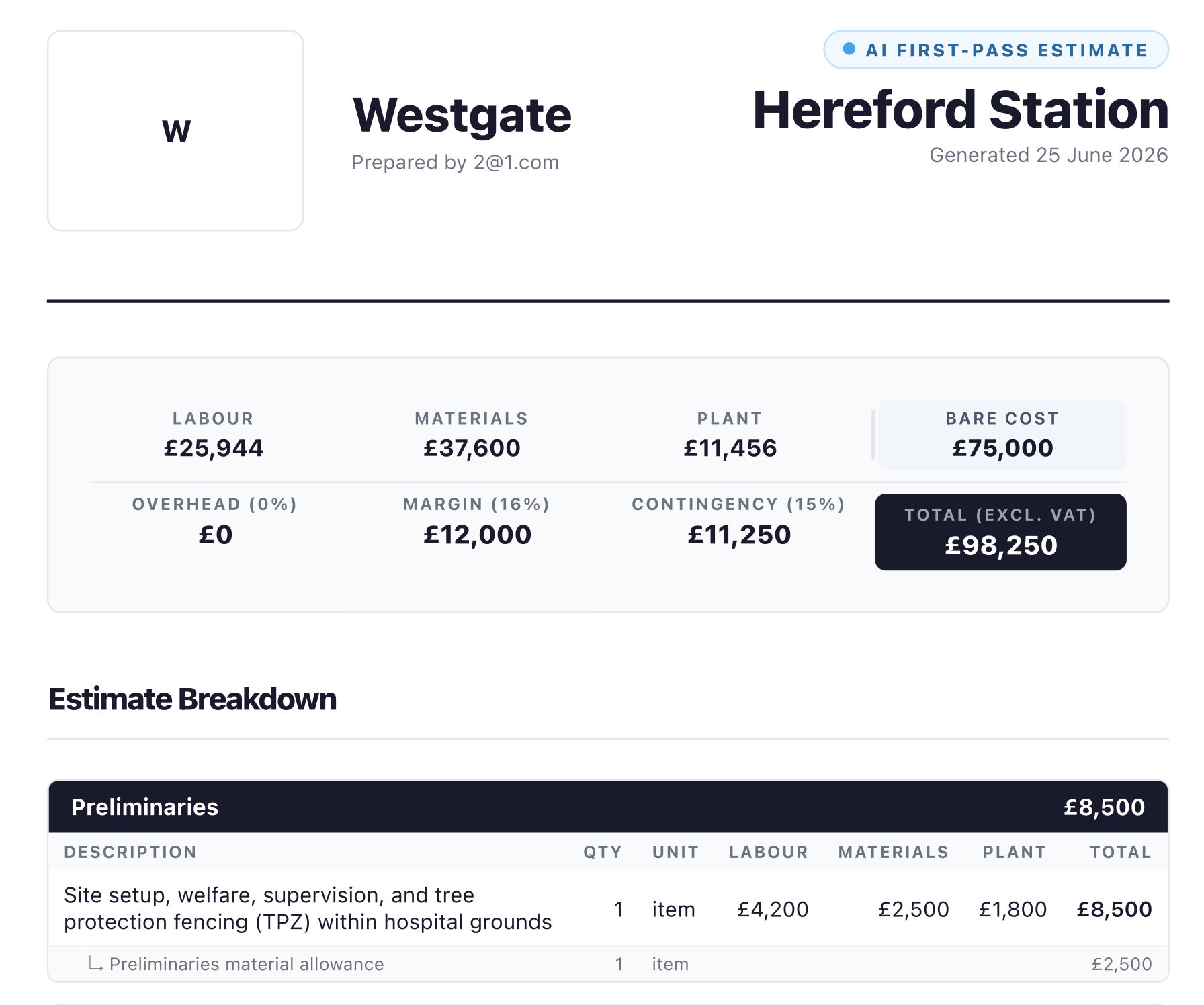
Quotify reflects this distinction. It produces a structured first-pass estimate from the project pack in 30 minutes or less, according to the current product workflow. The contractor then reviews and adjusts the scope, quantities, rates, risk, margin and final price. Create a structured first-pass estimate with Quotify.
That is where estimating speed is most useful: reducing the time required to reach the commercial decisions, not pretending those decisions no longer matter.
FAQs
How many hours should a construction estimate take?
There is no reliable universal number. The required time depends on the intended output, project complexity, information quality, subcontract input and review requirements. For substantial fixed-price projects, expect the process to involve hours or days rather than treating it as an instant calculation.
Why do construction estimates take so long?
The difficult work is normally understanding scope, finding missing information, calculating quantities, obtaining prices, documenting assumptions and reviewing commercial risk—not creating the final PDF.
Can a construction estimate be produced in one day?
Sometimes. A well-documented project using familiar work packages and available rates may support a useful estimate quickly. A fixed-price quote should not be issued simply because a one-day target exists if important scope or pricing questions remain unresolved.
Is a quick estimate less accurate?
Not necessarily. A fast structured first pass can be useful when it makes its information basis and uncertainty visible. Speed becomes dangerous when a quick total is presented as a fully reviewed fixed price.
How can builders reduce estimating time?
Reduce repeated document processing, standardise scope structures, maintain controlled rates, send specialist enquiries earlier and preserve the evidence behind the estimate. Keep final risk, margin and approval decisions with experienced people.
Use this thinking on a real project pack
Send drawings, specifications, notes or a current quote. Quotify will show how the project can be structured for review.