
A useful rate library records the basis behind each number, not just the number itself.
- What a construction rate library should do
- Decide what type of rates you need
- Give every rate a clear basis
- Separate cost from the commercial decision
- Use consistent work packages and units
- Record evidence, dates and confidence
- Test rates against completed estimates
- Set a practical review process
- Common rate-library mistakes
- A useful minimum structure
- How Quotify fits
A construction rate library can save an estimator from rebuilding the same labour, material and plant calculations every time a tender arrives.
It can also make an estimate confidently wrong.
The difference is not the size of the database. It is whether each saved rate has a clear basis.
A brickwork rate without a defined wall build-up, labour basis, waste allowance, access assumption or review date is not reusable pricing intelligence. It is a number detached from the job that produced it.
The purpose of a rate library is therefore not to automate commercial judgement. It is to preserve reliable estimating work so that the estimator can spend more time reviewing the project-specific decisions.
What a construction rate library should do
A useful rate library should help a contractor:
- avoid rebuilding common cost calculations
- price similar work consistently
- separate labour, materials, plant and subcontract costs
- see what is included in each rate
- identify rates that need a supplier or subcontractor check
- compare current pricing with previous projects
- update common assumptions in one controlled place
- explain how an estimate was constructed
It should not be treated as a universal price book.
Two apparently similar refurbishment projects can have very different access, sequencing, protection, logistics and making-good requirements. The saved rate may provide a starting point, but the estimator must still decide whether its basis fits the project in front of them.
Decide what type of rates you need
“Rate” can describe several different things. Mixing them in one column creates avoidable mistakes.
- Material rates. The cost of a product or material per unit, such as per sheet, tonne, metre or square metre.
- Labour rates. The cost of labour time, expressed by hour, day, gang or productive unit.
- Plant rates. Hire or ownership cost by hour, day or week, with delivery, fuel and operator assumptions stated separately.
- Composite rates. Labour, materials and sometimes plant combined into an installed unit rate.
- Subcontract package rates. A specialist quotation or benchmark for a defined package of work.
- Preliminary cost rates. Time-related or fixed project costs such as supervision, welfare, security and site setup.
These categories should remain visible. If an installed rate changes, the estimator needs to know whether the movement came from material cost, labour productivity or another assumption.
Give every rate a clear basis
The number is only one field in a reliable rate record.
Labour
A labour rate should explain:
- the trade or gang composition
- whether it is an employee, agency or subcontract basis
- the working day or hours assumed
- what employment or business costs are included
- the expected output under defined conditions
- whether supervision is included
- the region and review date
The wage paid to an operative is not necessarily the labour cost that belongs in an estimate. The business may also need to account for non-productive time, employer costs, travel, small tools, supervision or other overheads, depending on how its estimates are structured.
Productivity must also be separate from cost. An accurate day rate combined with an unrealistic output assumption still produces a poor unit rate.
Materials
A material rate should state:
- the exact product or specification
- unit and pack size
- supplier or evidence source
- discount basis
- delivery treatment
- waste allowance
- fixings or accessories included
- quote validity or review date
- whether the amount includes or excludes VAT
The UK government publishes monthly construction-material information, including price indices and selected production data. This is useful market context, but it does not replace a current supplier price for a live tender. Review the official building materials and components statistics.
Where a material is a large or volatile part of the project price, the correct action may be to obtain a project-specific quotation rather than automatically uplift an old library rate.
Plant
A plant rate should distinguish between hire period, delivery and collection, operator, fuel or charging, attachments, insurance or damage waiver, minimum hire and standing time.
A saved weekly excavator rate is of limited use if the estimator cannot tell whether transport, operator and fuel were included.
Subcontract packages
A subcontract rate should preserve the quotation basis, not just the total. Record the supplier or subcontractor, project and date, drawing or specification revision, inclusions, exclusions, quantity or package basis, attendance requirements, preliminaries, programme assumptions, quotation validity and unresolved clarifications.
A historical roofing package may be a useful benchmark. It should not be copied into another estimate until the estimator has checked area, build-up, access, scaffolding, penetrations, insulation, rainwater goods, warranty and making good.
Separate cost from the commercial decision
A rate library should normally preserve the cost basis before project-specific margin, contingency and risk decisions are applied.
Keeping these layers separate helps the estimator answer three different questions:
- What is the work expected to cost?
- What uncertainty does this project carry?
- What price is the business prepared to offer?
If margin is embedded invisibly inside historical rates, the estimator may apply it again—or assume it exists when it does not.
The same applies to contingency. A contingency applied to one difficult refurbishment should not quietly become part of the standard rate used on the next job. Read more about protecting margin on larger fixed-price projects.
Use consistent work packages and units
A rate library becomes easier to search and compare when it follows a consistent structure.
RICS New Rules of Measurement provide standard measurement rules and guidance for construction cost management. A contractor does not need to recreate a full professional measurement system to benefit from the principle: comparable work should be described and measured consistently. Read the RICS New Rules of Measurement overview.
For each saved rate, define the work package, item description, unit, inclusions, exclusions, quantity range, project type and applicable conditions.
Avoid descriptions such as “roofing — £/m²” when the library could say what roof system, insulation, deck, finish and associated work the rate covers.
Consistency also makes historical comparisons more useful. If demolition is sometimes stored by square metre, sometimes by daywork and sometimes inside a larger package, performance cannot be compared without reconstructing each estimate.
Record evidence, dates and confidence
Every important rate should answer four questions:
- Where did it come from?
- When was it checked?
- What does it include?
- How confident are we that it applies here?
The Office for National Statistics constructs its UK construction output price indices using materials, plant and labour inputs before applying a mark-up. That does not prescribe how an individual contractor should price a project, but it reinforces why those cost components should remain distinguishable. Review the ONS construction output price-index methodology.
A simple confidence system can help:
- Verified: supported by a current supplier or subcontractor quotation
- Reviewed: checked recently against reliable evidence
- Historical: taken from an older estimate or completed project
- Provisional: usable for an early first pass but requires confirmation
- Project-specific: not intended for general reuse
Confidence should not be used to disguise uncertainty. It should tell the estimator where review time is needed.
Test rates against completed estimates
Do not judge a library only by how quickly it produces a tender.
Compare saved rates with current supplier and subcontractor returns, final reviewed estimates, purchase orders where comparable, actual labour output where records are reliable, and major differences identified during commercial review.
The purpose is not to replace estimating with job-cost reporting. It is to find recurring weaknesses.
If a labour allowance is repeatedly low, investigate the underlying output assumption. If a composite rate regularly needs manual additions for access or protection, the rate description may be too broad. If estimators repeatedly override a rate, the library may no longer reflect how the business buys or delivers the work.
Use Quotify's fixed-price estimating review checklist when checking how rates sit inside the wider estimate.
Set a practical review process
A smaller controlled library is more useful than thousands of unreviewed items.
Assign ownership and create review triggers. A rate might need checking when its review date expires, its supporting quotation is no longer valid, the specification changes, the project is in a different region, the quantity falls outside its normal range, access or programme conditions differ, a new estimate produces an unusual variance, or an estimator overrides it repeatedly.
Use scheduled reviews for common rates, but do not rely on a calendar alone. Project conditions should also trigger review.
Common rate-library mistakes
- saving numbers without inclusions or exclusions
- mixing supply-only and installed rates
- embedding margin invisibly
- using one labour output across every project condition
- carrying project-specific risk into standard rates
- ignoring delivery, waste, access or minimum-order costs
- overwriting old evidence without retaining a history
- applying blanket percentage uplifts instead of checking important items
- treating a national index as a substitute for a live supplier quote
- building a huge database nobody trusts
A rate library should make the reasoning behind the estimate easier to inspect. If it only produces a faster total, it has solved the least difficult part of estimating.
A useful minimum structure
Start with these fields:
| Field | Purpose |
|---|---|
| Rate ID | Provides a stable reference |
| Work package | Organises the library |
| Item description | Defines the work or product |
| Rate type | Material, labour, plant, composite or subcontract |
| Unit | States how the rate is applied |
| Base cost | Preserves the underlying cost |
| Inclusions | Explains what is covered |
| Exclusions | Prevents false assumptions |
| Evidence source | Links to the quotation, invoice or calculation |
| Region | Shows geographic relevance |
| Review date | Identifies freshness |
| Confidence status | Directs estimator attention |
| Notes | Records conditions and limitations |
A spreadsheet can hold this structure initially. The important decision is not the software. It is whether the information remains controlled, searchable and visible inside the estimating process. When stronger search, version control or workflow integration becomes necessary, review what construction estimating software for UK builders should provide.
How Quotify fits into the process
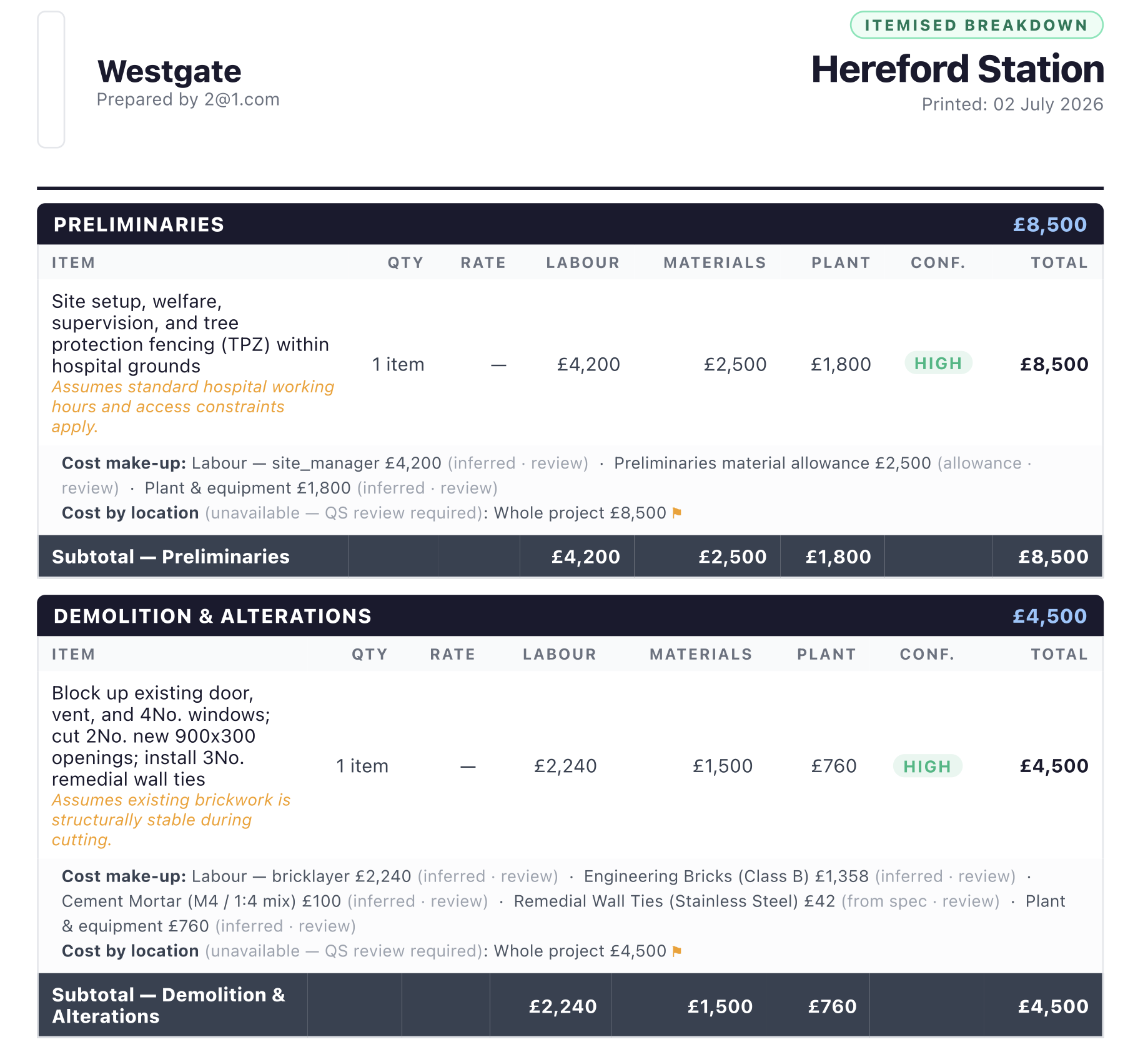
Quotify is designed to create a structured first-pass estimate from drawings, specifications and supporting project information while leaving rates, margin and the final price under the contractor's control.
A rate library strengthens that process by giving the first pass a clearer business-specific starting point. It does not remove the need to check the drawings, challenge quantities, confirm supplier prices or apply commercial judgement.
Have a live project to price? Send the project pack through Quotify and compare the structured first pass with your current estimating process.
FAQs
What is a construction rate library?
It is a controlled collection of material, labour, plant, composite and subcontract rates used as starting points when preparing estimates. Each rate should include its basis, evidence, review date and limitations.
Should a rate library include margin?
Usually, the underlying cost and the commercial uplift should remain distinguishable. This helps prevent margin being applied twice or omitted accidentally and allows project-specific decisions to remain visible.
How often should construction rates be updated?
There is no single interval suitable for every rate. Review frequency should reflect the importance of the item, the age and validity of its evidence, market movement and how sensitive the project total is to the rate.
Can historical project rates be reused?
Yes, as benchmarks or starting points, provided the estimator checks scope, specification, quantity, location, programme, access and date before applying them to a new project.
Do I need estimating software to build a rate library?
No. A controlled spreadsheet can be a sensible starting point. Software becomes valuable when the business needs stronger search, version control, evidence links, shared governance or integration with the estimating workflow.
Use this thinking on a real project pack
Send drawings, specifications, notes or a current quote. Quotify will show how the project can be structured for review.