Understand the commercial reports builders can use to review price, scope and risk.
- Start with the decision you need to make
- Understand the main document types
- Brief the report before work starts
- Check the basis behind the figures
- Ask for conclusions and next actions
- Understand what software-generated reports provide
Before requesting a QS report, finish this sentence: “I need this document so I can decide…”
Whether to proceed with a design? What to include in a tender? Which subcontractor return to carry into the estimate? Whether the price is ready for approval?
Each question needs different information.
“QS report” is a broad description. It can refer to several commercial documents, and their scope depends on the brief. Choosing the right one starts with the decision it must support.
Start with the decision you need to make
Tell the person preparing the report what you intend to do with it.
A contractor considering an early design needs an explanation of likely cost and uncertainty. An estimator preparing a tender needs a usable scope and pricing basis. Someone comparing subcontractors needs the differences between their offers made visible.
The document should suit the project’s information stage as well as its purpose.
The UK government’s cost-estimating guidance explains that estimating methods should reflect the maturity of project information and the decision being supported. Although written for infrastructure projects, that principle is useful when briefing reports for building work. Government Cost Estimating Guidance
A detailed-looking document cannot supply design information that has not yet been established.
Understand the main document types
These descriptions explain common uses. Confirm the exact deliverable with its author rather than relying on the title.
| Document | Main purpose | Important question |
|---|---|---|
| Cost plan | Help manage the budget as the design develops | What design and cost assumptions underpin it? |
| Bill of quantities | Describe and quantify work in a structured format for pricing | What measurement basis and information were used? |
| Internal estimate | Build and review the contractor’s project price | Which costs, allowances and commercial adjustments are included? |
| Tender comparison | Examine competing offers on a clear basis | Which scope and qualification differences remain? |
| Risk or assumptions report | Explain uncertainty and its proposed treatment | What decision or further information is needed? |
Cost plan
A cost plan helps the team understand the allocation of expected costs and review design choices against the budget.
Check its coverage. Does it address construction work only, or also other project costs? What has been allowed for risk, inflation or incomplete information?
Its usefulness depends on those boundaries being clear.
Bill of quantities
A bill of quantities provides descriptions and quantities arranged for pricing. It may be issued unpriced or returned with prices.
A priced bill still needs review: the presence of quantities and rates does not, by itself, explain every assumption or establish that the overall offer is ready.
RICS distinguishes between NRM 1, covering order-of-cost estimating and cost planning, and NRM 2, covering detailed measurement for building work. This helps explain why different cost documents use different structures. RICS New Rules of Measurement
Internal estimate
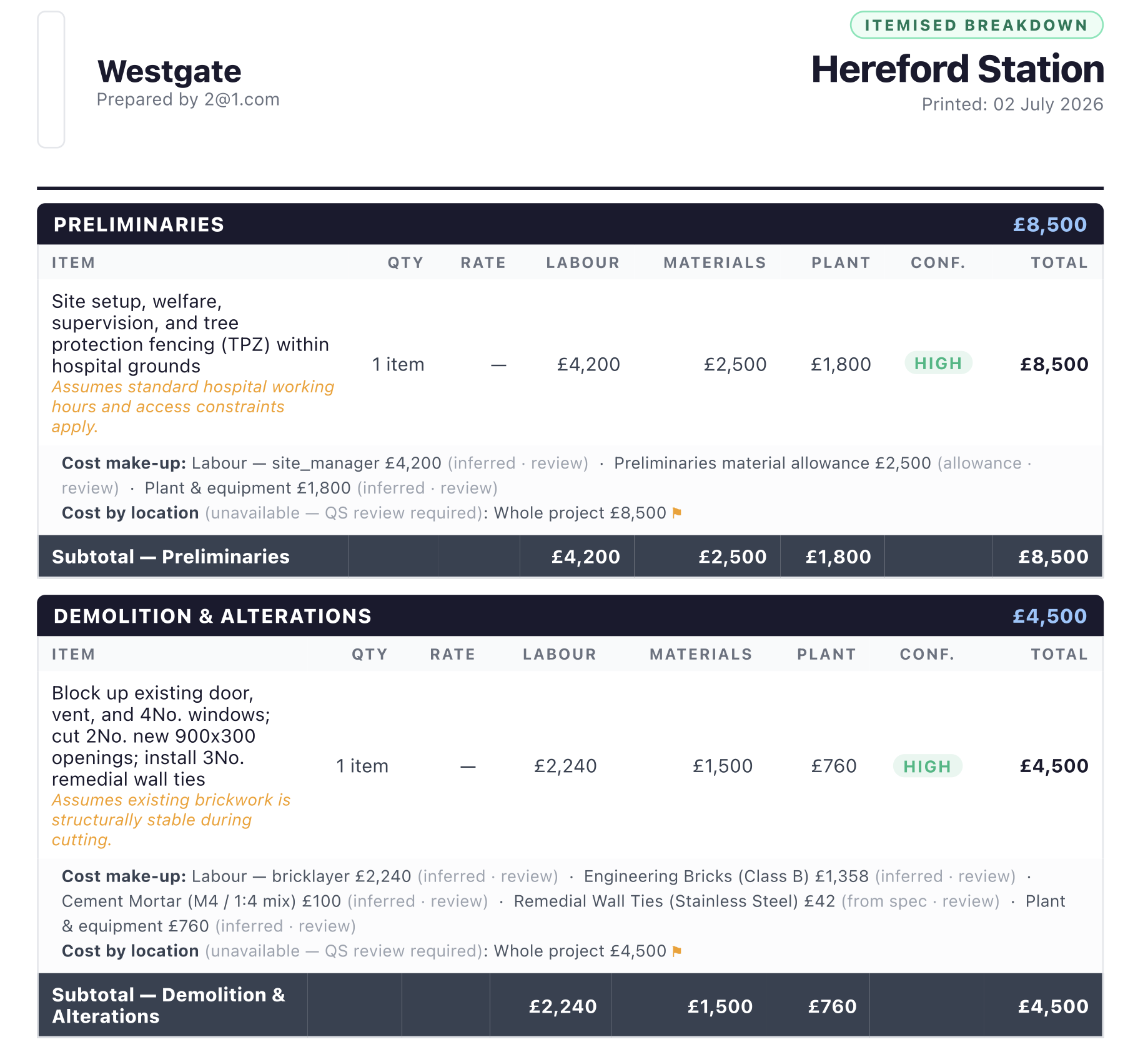
The internal estimate should let the contractor inspect how the price has been assembled.
Depending on the method, that may include quantities, labour, materials, plant, subcontract packages, preliminaries, overhead and profit. The treatment of allowances and risk should also be understandable.
This is the document used to challenge the commercial build-up before producing the client offer.
Tender comparison
A comparison should explain the differences between returns, alongside their totals.
For example, one quotation may include installation while another covers supply only. A useful comparison identifies the difference and records any adjustment made for evaluation.
Use the subcontractor quotation comparison guide for a detailed approach.
Brief the report before work starts
A short written brief can prevent a mismatch between the document delivered and the information needed.
Include:
- The decision the report should support
- The project stage and available documents
- The scope to be assessed
- The required breakdown and format
- The pricing date and programme assumptions
- Known gaps or unresolved selections
- The deadline and intended readers
- Any specific review or follow-up required
Ask the author to confirm what is included in their service and what falls outside it.
“Prepare a cost report” leaves room for different interpretations. “Review these package returns and identify scope differences before we choose the amount for the tender” gives the work a clearer purpose.
Check the basis behind the figures
When the report arrives, read its basis and limitations before relying on the total.
Confirm the documents and revisions used. Check how the author treated missing information, allowances, exclusions and tax.
Then establish what supports the important amounts. They may come from quotations, measured quantities, historical information or a reasoned allowance. Those sources carry different review needs.
A figure copied from a previous project needs context. A supplier quotation needs its scope and validity checked. An allowance needs an explanation of what it covers and what will resolve it.
The construction rate-library guide explains how to preserve useful pricing evidence.
Where the report contains PC sums or provisional allowances, check their individual basis using the allowances guide.
Ask for conclusions and next actions
A useful report should help the reader decide what to do next.
Depending on the brief, that might mean clarifying a design issue, obtaining a package quotation, reviewing a major allowance or confirming that a comparison is complete enough for a decision.
Separate findings from recommendations. “The return excludes access equipment” is a finding. “Obtain an access allowance before approving the package” is an action.
If a report identifies significant uncertainty, ask how that affects its intended use. Do not let an unresolved recommendation disappear when the figures are transferred into another document.
Before submitting a price, use the wider construction estimating checklist.
Understand what software-generated reports provide
Quotify helps contractors turn project information into a structured first-pass estimate, detailed breakdown and client-ready quote.
The contractor retains responsibility for reviewing the scope, rates, assumptions, margin and final price.
A software-generated report should be assessed by its contents, evidence and review status. Its layout alone does not establish that an independent professional has checked it.
If a project needs a specific professional service, define that requirement and confirm who will provide it.
Have a live project to price? Book a Quotify demonstration with a representative pack and assess whether the output supports the decisions you need to make.
Choose the report by its purpose. Then check that its information is sufficient for the decision ahead.
Review checklist
- Name the report purpose and information date
- Show the measurement and pricing basis
- Separate allowances and exclusions
- Identify the decisions the reader must make
FAQs
What is a quantity surveyor report?
A commercial document covering measured work, cost planning, tender comparison, allowances, risk and contract cost control.
Do builders need a QS for every project?
No. The need depends on value, complexity and risk, but structured QS-style reporting can still help.
Use this thinking on a real project pack
Send drawings, specifications, notes or a current quote. Quotify will show how the project can be structured for review.